Your franchisees sign the leases. I make sure they open.
A standing construction partner your development team can point franchisees to: the same five-phase playbook on every unit, in any market, with a live client portal your team can watch 24/7, so construction problems get caught while they're still cheap. No new person on your payroll.
Every late opening is royalty you never collect.
A unit that opens ninety days late doesn't just cost the franchisee rent on a dark space. It costs you a quarter of royalties, pushes your development schedule, and puts a first-time operator under financial stress before their first customer walks in. And when a buildout goes badly, the story travels through your franchisee community faster than any success does. The lease that hid a $60,000 electrical upgrade. The low bid that came back as change orders.
None of that is your construction team's fault. It's arithmetic: a two- or three-person development department can't project-manage every unit in a growing system. Somebody has to stand next to the franchisee through the parts that go wrong. That's the job I do.
Three problems, one root cause.
The root cause: nobody trade-literate is standing on the franchisee's side of the table.
Franchisees are first-time developers.
They're excellent operators and complete rookies at construction: signing LOIs without feasibility checks, trusting "should be plenty," picking the low bid because it's low. They don't know what they don't know, and the lease doesn't care.
Your construction department is stretched.
Design reviews, site approvals, vendor programs, and forty open units: your team steers the brand. It was never staffed to chase a GC's submittal log in a market two time zones away, and every escalation that reaches them is one that got expensive first.
Brand standards drift, one unit at a time.
Value engineering nobody approved, substitutions nobody flagged, a prototype adapted by whoever was cheapest that week. Each deviation is small. Multiply by a system, and the brand your customers see stops matching the one you designed.
One partner. One playbook. Every unit.
The same playbook on every buildout.
Five phases and a documented milestone plan calibrated to your brand standards once and then repeated: 100-200+ milestones on a tenant improvement, 240+ on ground-up. Your tenth unit gets the same diligence as the first, because none of it depends on memory. See the system →
Site and lease diligence that prevents dead deals.
Conversion shells hide fifty to a hundred and fifty thousand dollars in surprises: exhaust paths that can't reach the roof, 100-amp services where the kitchen needs 400, no place for a grease interceptor. My pre-LOI quick-vet kills bad sites in days, before your franchisee spends legal fees and your pipeline loses a quarter.
Brand standards enforced by someone who reads drawings.
I verify design against your current prototype and standards at every drawing milestone, track deviations to written resolution, and catch the substitutions before they're installed. Trade-literate enforcement, not a checklist glance.
Visibility without chasing.
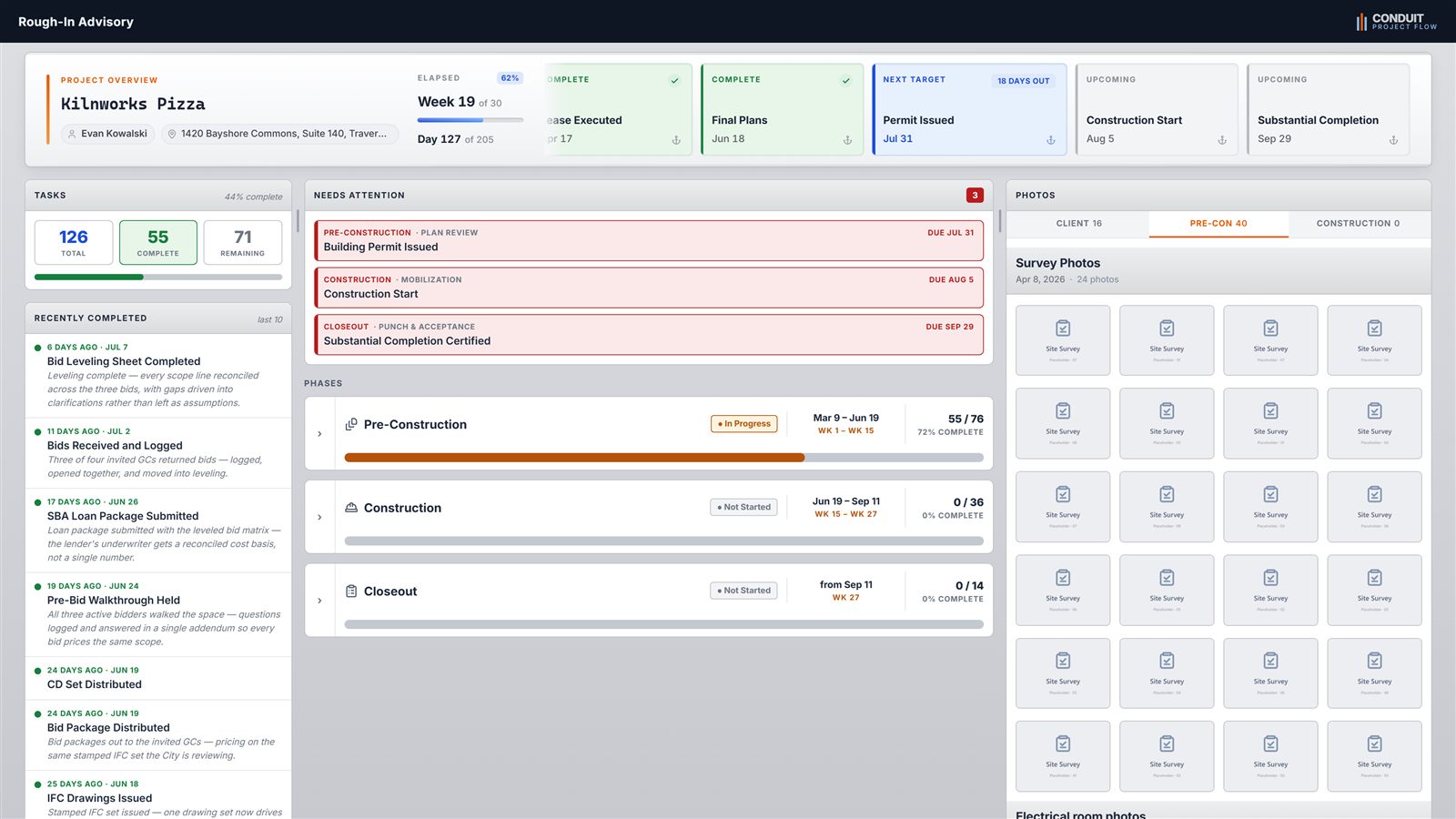
Monday progress calls with the GC, and a client portal that runs 24/7: every milestone with its date, the task-by-task progress, the photo record, the open items, and projected dates that recalculate as actuals land. With the franchisee's consent, your development team watches the same portal I run the job from. You find out about problems when they're small, without having to ask.
SBA fluency, because that's how franchisees build.
Most of your operators are building on 7(a) money. I handle the draw documentation, lender coordination, and lien waiver discipline that keeps funds releasing on schedule. The paperwork stall is what quietly adds weeks to openings.
Any market, without adding headcount.
The remote-first model (structured documentation, directed video walks at rough-in and final) scales from one unit to a multi-state rollout with no per-city dependency. Your franchisees fund their own engagements; your team gets a consistent standard of oversight.
The buildout runs on software I built. So does your visibility.
Every engagement runs on Conduit Project Flow, the project management platform I built for exactly this work. Your franchisee gets a PM. You get a window: a live client portal that tracks the whole job, 24/7, from any browser.
It isn't software I'm selling you. It's how every unit gets the same discipline, and how you watch it happen without asking anyone for a status report.
- Every milestone with its date, and projected dates that recalculate as actuals land. When the permit issues, everyone's opening date firms up automatically.
- A needs-attention queue that surfaces problems while they're still cheap. The twelve-week switchgear lead gets flagged in July, not discovered in an October phone call.
- A plain-English activity feed your team can skim in thirty seconds, and a categorized photo record from survey through construction.
- Access is per-project and read-only, shared with the franchisee's consent. Their financials never cross to the portal. The same wall protects your brand data.
Pilot one unit. Judge the difference.
I'm not asking to be written into your FDD tomorrow. Route me one buildout and measure the result against your last ten.
Pick a unit.
One franchisee, one site. Ideally the kind that's burned you before: a conversion shell, a first-time operator, a market with no bench. We scope the engagement directly with the franchisee. Fixed fee, defined phases.
Calibrate the playbook.
I adapt the milestone framework to your prototype, brand standards, and approval workflow. Once. Every subsequent unit inherits the calibration, and your development team's preferences become part of the system.
Scale on results.
If the reporting, the diligence, and the opening speak for themselves, we talk about a standing arrangement: recommended vendor, preferred partner, whatever structure fits your system. If they don't, you've risked one unit.
The questions development teams actually ask.
The franchisee. It's their project and their contract: fixed-fee, phase-based, scoped before work starts. Your system gets the consistency benefit without a line item. I stay independent of GCs and vendors: no referral fees, no markups, nobody's interests in my pocket but the owner's.
No. I make whatever GC builds the job accountable to what they bid. If you run an approved-GC program, I work inside it: bid packages, line-by-line bid scrutiny, and a documented clarification record attached to the contract. Your good GCs will like working this way. The other kind won't, which tells you something too.
I extend it; I don't compete with it. Your team keeps prototype, standards, and site approval authority. I'm the unit-level execution arm that stands next to the franchisee daily. The escalations that reach your desk arrive early, documented, with a recommendation attached.
Yes. The playbook carries a parallel ground-up framework: site selection and due diligence through entitlements, vertical construction, and CO, built to the same documentation standard as the tenant-improvement workflow.
Because the method doesn't live in my head. It lives in a documented milestone system and the software I built to run it. You're not betting on my memory; you're getting a process you can inspect. And one accountable name beats a rotating cast of coordinators. When you call, the person who answers is the person who read your lease.
Route me one unit.
Bring the buildout that's keeping your development team up at night. Thirty minutes, direct, no pitch deck. I'll tell you straight what I see and how I'd run it.
Start the Conversation